Quartz cat’s eye and fibreglass imitations are widespread and much cheaper than chrysoberyl. A report identifying the species as chrysoberyl is essential. Judge the eye itself under a single light source: it should be straight, sharp and centred, and it should open and close cleanly as the stone rotates.
What cat’s eye actually is
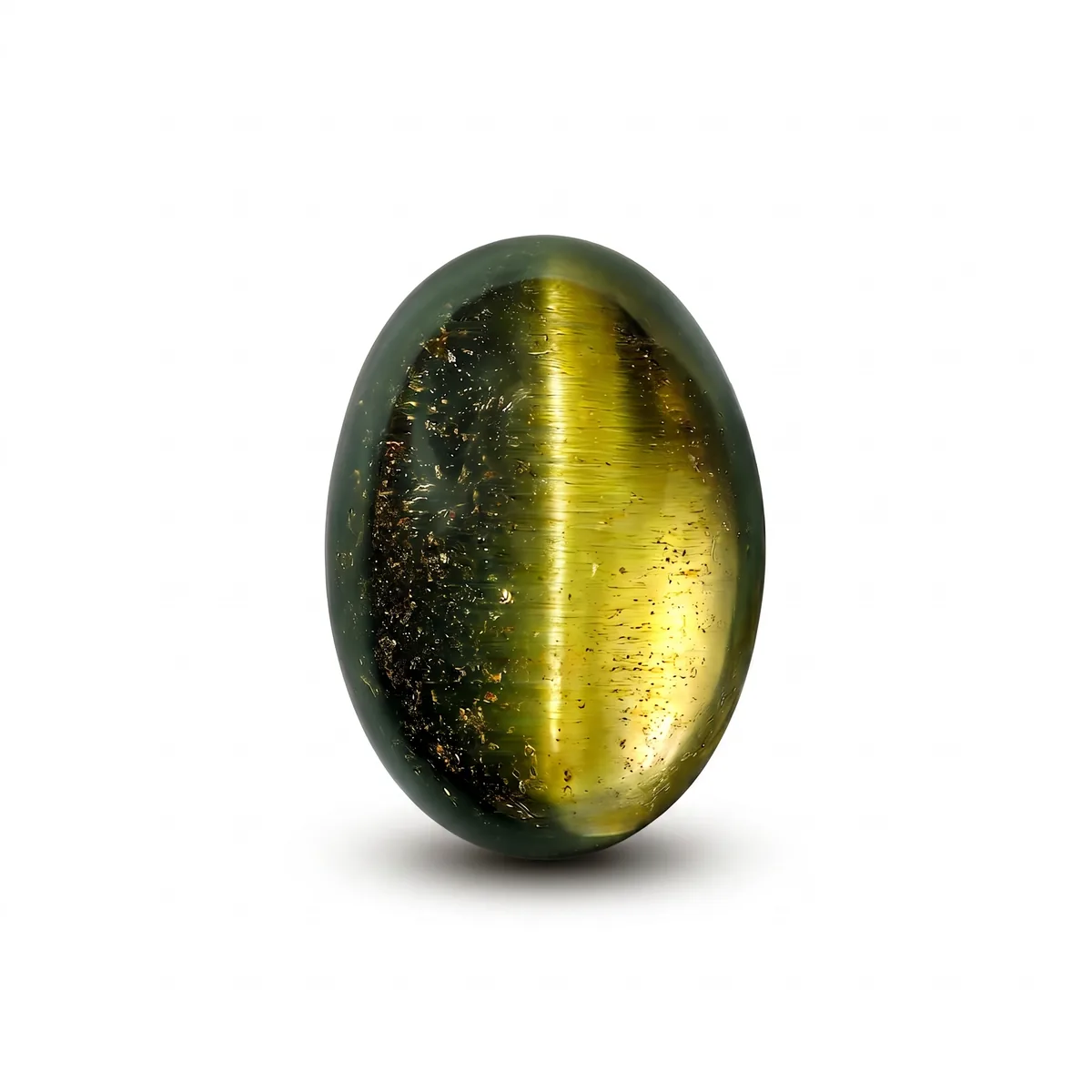
Cat’s eye is chrysoberyl, a beryllium aluminium oxide sitting at 8.5 on the Mohs scale, and the only Navratna stone bought for an optical effect rather than for a colour. The effect, chatoyancy, comes from a dense parallel arrangement of microscopic tubes or needles that reflect a single band of light across a domed cabochon. Body colour runs from a honey gold through olive to a greyish green, and the finest material shows the milk and honey effect, where the dome reads light on one side of the band and dark on the other.
What gets sold as Lehsunia instead
Almost everything sold as cat’s eye is not chrysoberyl. Quartz cat’s eye is the commonest, and it is a genuine chatoyant stone worth a small fraction of chrysoberyl. Cat’s eye tourmaline, apatite, scapolite and moonstone all occur and are all cheaper. The outright imitation to know about is fibre optic glass, sometimes called cat’s eye glass, which is manufactured in bulk in a range of colours and shows an implausibly perfect band; its giveaway is a honeycomb pattern of fibre ends visible on the flat base under magnification. Because Lehsunia is bought for an effect rather than for a colour, and because the effect is easy to manufacture, this is the stone on the list where a species report matters most and where the price gap between the real material and the imitation is widest.
What to look for, and what to ask
Insist on a report identifying the species as chrysoberyl. Quartz cat’s eye, glass fibre optic imitations and cat’s eye tourmaline are all sold as Lehsunia, all show a band of some kind, and all cost a fraction of chrysoberyl. Judge the eye under a single point source rather than diffused light: it should be a sharp, straight, centred line that opens and closes cleanly as the stone is rotated, not a broad silvery smear. A band that sits off centre or wanders is a cutting fault and prices accordingly.
Weight, and what it costs in this stone
Chrysoberyl cat’s eye is scarce at any size and becomes disproportionately scarce above a few carats, because the stone has to be cut as a dome oriented precisely across the fibre direction, which throws away a great deal of rough. Weight is therefore expensive here in a way it is not in Gomed. It is also the wrong thing to optimise: a smaller stone with a sharp, straight, centred band that opens and closes cleanly is worth more than a larger one whose eye is broad, wandering or off centre, both to the trade and to anyone looking at it.
Wear and care
At 8.5 chrysoberyl is harder than almost anything it will meet in daily wear and has no significant cleavage, which makes it one of the more robust stones in the Navratna set. Warm water, mild soap and a soft brush. The cabochon dome is where wear shows first, so a stone worn daily for years may want repolishing rather than replacing.
As practised in Vedic tradition. Your astrologer’s instruction takes precedence over any general rule.